
When School Readiness Becomes a Blame Game - And Why That Helps No One
January 2026 started with a bang.
I have been busier than I can ever remember: working, solo parenting, juggling competing needs, and trying to hold everything together while my wisdom teeth feel as though they are pulling my face apart. I have posts drafted, notes written, thoughts ready but not enough hours in the day to finish them all.
Yesterday as I was getting my daughter ready for school, the news was on in the background. I wasn't planning to write a blog this week. But as soon as the conversation turned to school readiness and toilet training, I knew this was a post that couldn't wait.
Because this one hits home for me.
School readiness was discussed on BBC Breakfast, with a particular focus on toilet training along with a guide taking parents back to basics with recommendations such as "step 1 - buy a potty."
During the segment, it was stated by 30 months, all children should be out of nappies, except those with a bowel diagnosis. It was also suggested that nursery staff are struggling because parents don't try.
What was missing from that conversation was not accountability, but context.
This Is Not an Excuse: It Is an Omission
Before I continue, I want to be clear from the outset, this is not about excusing a lack effort - it is about acknowledging that some children were not accounted for at all.
There was no space given to children whose development does not follow typical timelines and not because of parental choices, but because of how their nervous systems, communication, and sensory processing function.
Children who are pre-verbal, children who do not yet recognise bodily cues, children with sensory differences, regulation needs, or developmental profiles that sit outside of neat categories. Children who are pre-diagnosis, on waiting lists, or who may never receive actual support.
Those children do exist, they are already in our nurseries and schools.
Introducing NCIS
Throughout this piece, I reference an approach that I created and use both professionally and personally. It is called the "Bamboo Neuro-Constructive Inclusive System" (NCIS).
NCIS is not a programme, checklist, or behavioural model. It is a systems framework for understanding development that prioritises regulation, observation, and adaptation over pressure, compliance, or age-based expectation.
At its core, NCIS is built on one guiding principle:
Children progress when systems adapt to them, not when children are forced to adapt before they are ready.
This principle applies across home, early years, schools, and wider support services. It reframes "readiness" as something that is constructed through safe, responsive environments, rather than demanded through timelines.
NCIS in One View
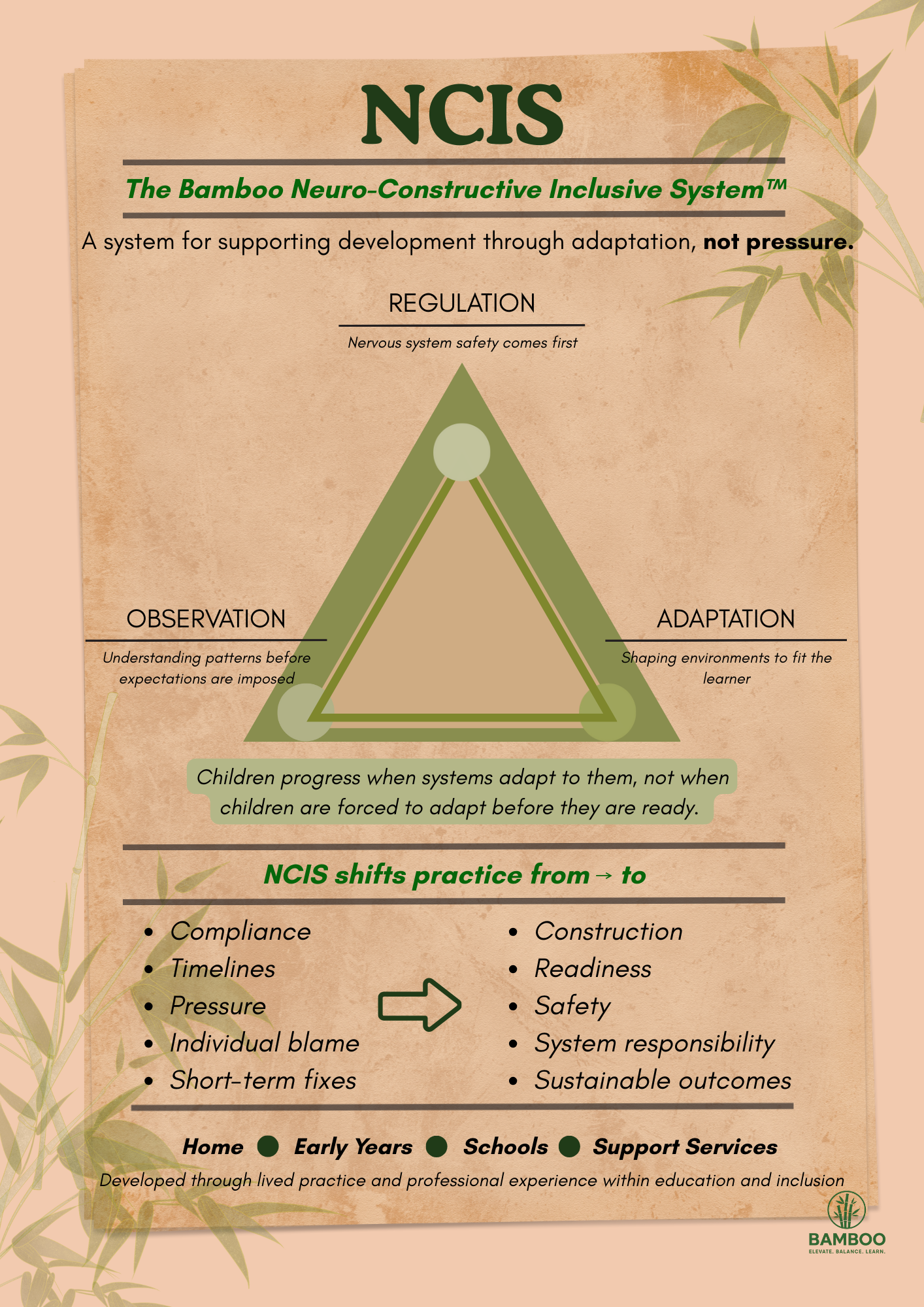
NCIS - a systems framework built through lived practice and professional experience.
The Architecture Behind NCIS
NCIS is underpinned by six core pillars that guide how regulation, adaptation, and inclusion are implemented in real environments. Together, these pillars translate the NCIS principle into practice.
I will be sharing each pillar in more detail in a separate blog.
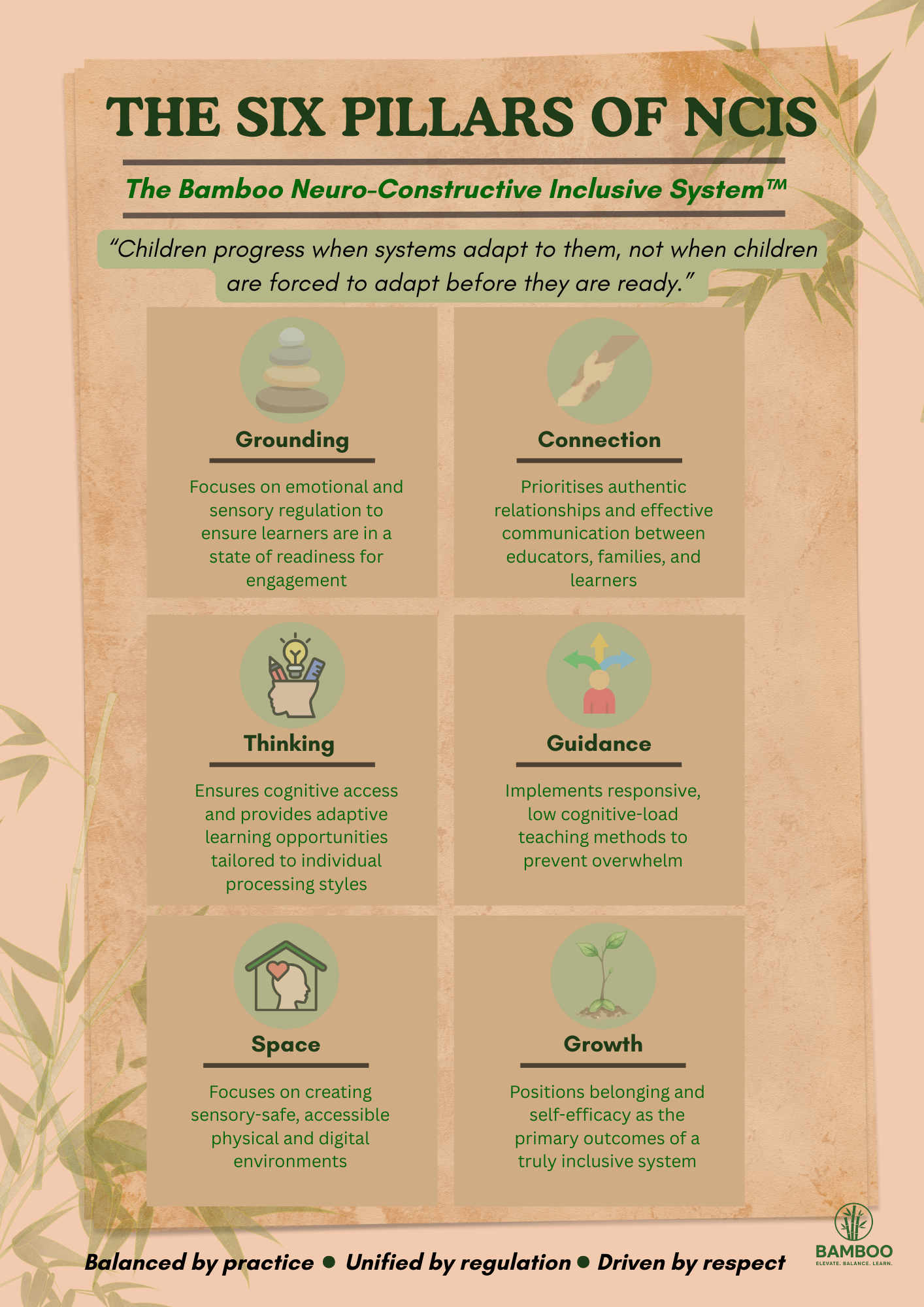
The Six Pillars of NCIS - the structural foundations that enable meaningful, sustainable inclusion.
What follows isn't theory, it is NCIS in practice and how these principles and pillars played out in real time, in a real family (my family), and within real system constraints.
When "Trying" Is Not the Issue
My son will be five in March and as you all are now aware, he is autistic and preverbal. For a long time, he did not know when he needed the toilet and he could not tell anyone even if he did.
When he was in nursery, he regularly came home soiled in multiple pairs of underwear, unable to communicate discomfort, distress or need. This was not a toileting delay, but it certainly became a serious safeguarding concern.
There was no suitable placement able to meet his needs at that time. I did not remove him because I gave up, I had to because his dignity and safety mattered.
Here's What Worked For Us
Step One: Changing the Environment
The first thing that made an immediate difference was removing my son from nursery.
I am a single mother so working was never not an option for me. So, I reshuffled my life again and adjusted my business to fit his needs, this is not always possible for other families. I am and forever will be grateful to my students and their families because they have all stayed with me during that period of uncertainty. Without that, this would not have been possible.
Nursery environments are busy, loud and fast-paced. Staff are doing their best, but many are not trained to support complex learning and communication needs. A room of 30 babies or toddlers, some with additional needs, is not easy. Many nurseries rely on bank staff because permanent staff burn out and leave. There is very little specialist SEND nursery provision.
At this point, I was his only safe option.
Once removed, he was calmer. His nervous system settled, the environment became predictable and I could finally take the time that was necessary to observe him.
What looked chaotic in a busy setting became understandable in a calm one.
Step Two: Going Back to Basics: Without Pressure
I stopped trying to make him fit the process and shaped the process around him.
We returned to pull-ups, we actually removed the potty altogether because he was 4 and quite frankly too big to keep a potty, it wasn't comfortable for him anymore. I bought a small camping toilet similar in size to EYFS toilets, then later transitioned to a toilet seat with a mini ladder.
To get him to even sit, we did it while he was in a pull up. I played potty songs on his iPad (yes, the dreaded tablet that everyone goes on about) while he sat. This was a crucial step because it meant he sat long enough for something to happen. As soon as he was wet, we changed immediately - every time.
When I noticed his cues, I placed him on the toilet, in a pull-up, without pressure. This took some time but because our environment was calm, progress came more quickly than before.
Step Three: Building Awareness Before Independence
When he was ready, we used pull-ups like pants: off to wee, back on afterwards.
For number twos, I tried the same approach, it caused anxiety. So I stopped.
No forcing. No pressure.
Eventually, we moved into pants. There were many accidents, it was expected. But because of the routine we built together, his skin had become used to being dry. He didn't like the feeling of being wet anymore.
Now, he walks into the bathroom independently. He makes a sound so I know he's ready. Sometimes he undresses independently, sometimes with support and that is okay.
That is progress.
Step Four: Making the Process Visible
When he does a number two in a pull-up, I empty it into the toilet and let him flush.
He watches, in fact he knows this part of his routine.
That tells me he is already learning where it goes.
We flush, wash hands and carry on with our day.
One day and to be honest, I don't think it's far off at all, he will realise that it needs to go from his body straight into the toilet. Even if it means more accidents, I am prepared - I stock his underwear.
Progress is happening and not because he was forced. But, because he understood.
So we have gone from accidents all day, to being in pants all day, actively using the toilet and no accidents. Sometimes, when he knows he needs a number two, he brings the pull-up, this is also progress because he is developing the sense of when he has to go.
My next step is to remove the pull-up altogether during the day, so he starts getting that discomfort feeling when he has a number two accident, if I need to change tactic, I will think of something when the time comes.
I Understand How Hard This Is - Especially When You're Working
If anyone understands how difficult it is to work long hours and do this alongside everything else, it's me.
Parenting, running a business that requires me to work seven days a week is hard and even though I am exhausted, I know what I need to do.
That being said, I also understand that my situation is different in one important way: I can work from home, my students come to me. This shift, has allowed me to maintain consistency for my son in a way many families simply cannot.
I don't say that to compare or minimise, I say it because I recognise the reality of other parents. Which is why I posted this today. If what I have shared here helps even one parent adapt around a busy schedule, evenings, weekends or just small windows of calm, this is has been worth writing.
Support does not have to be perfect to be meaningful. Progress does not have to be fast to count.
I Understand Schools: This Is a System Issue
I also understand schools. I taught in schools for years so just as this is not about blaming parents, it's also not about blaming teachers.
In my professional opinion, it is not fair or realistic to place complex needs on one class teacher and one learning support assistant. Inclusion requires teams, not individuals stretched beyond capacity.
When teachers are overwhelmed, learning does not happen. Regulation breaks down. Environments become chaotic. Children stop progressing and it is not because they can't learn but because the conditions for learning no longer exist.
This is not isolated. This is a national issue and it is happening now.
NCIS in Practice: Not Theory
have shared here is not anecdotal.
It reflects how my Neuro-Constructive Inclusive System (NCIS) operates in real life.
NCIS places priority on the following:
Regulation before expectation
Observation before instruction
Adaptation before compliance
What looks like delay from the outside, is often the foundation building underneath.
Progression Is the Outcome
School readiness cannot be reduced to nappies and it cannot be discussed responsibly without accounting for neurodevelopmental difference, safeguarding, staffing and system design.
Pressure creates regression but adaptation creates progression.
My son is progressing because the system around him changed.
That is not an excuse but it is evidence and progression at every level is what winning actually looks like.